
How Condo & HOA Boards Can Reduce Legal Fees Without Increasing Risk
A guide for Michigan & Illinois community association boards. Jump to your question:
Where Boards Save the Most
- Get legal advice before a high-risk decision is made
- Ask for cost estimates on significant projects
- Use the right attorney for the right type of matter
Condominium and homeowners association boards have a responsibility to control legal expenses. But the best way to save money is usually not to avoid the attorney, rely on the cheapest lawyer, or substitute a property manager, Google search, or artificial intelligence for legal advice. The best approach is to budget realistically, involve counsel at the right time, use legal services efficiently, and avoid paying to correct preventable mistakes.
Start Here
The Most Effective Way to Reduce Legal Fees Is to Eliminate Unnecessary Legal Work
Boards can often do that by:
- Budgeting realistically for predictable legal needs
- Using clear procedures for recurring issues
- Getting legal advice before a high-risk decision is made
- Using one board member or manager as the primary legal contact
- Avoiding unnecessary internal emails to the attorney
- Asking for cost estimates on significant projects
- Using the right attorney for the right type of matter
- Keeping governing documents and policies current
- Using educational resources to recognize common legal issues earlier
The goal should not be to minimize every legal bill. It should aim to avoid unnecessary legal expenses while protecting the association and maximizing the value of the legal fees spent.
Information vs. Advice
Do Not Use AI, Google, or a Community Association Manager as a Substitute for Legal Advice
Community association boards have more sources of information than ever. Artificial intelligence tools, Google searches, community association managers, and other board members can all be useful for general information. But they are not substitutes for legal advice on higher-risk issues.
AI and online research may not account for a condominium or homeowners association’s actual governing documents, municipal requirements, applicable state law, federal law, or the specific facts involved, and it may not even know the correct questions to ask to provide an accurate answer. Similarly, many free AI tools will hallucinate and provide inaccurate information. In most cases, using these tools to create draft policies, letters, or amendments to governing documents typically requires more time for an attorney to fix than starting from scratch.
Community association managers can also be highly knowledgeable about association operations, but their role is different from that of a community association attorney. Legal questions involving Fair Housing, governing document interpretation, enforcement authority, contracts, collections, fiduciary duties, or potential litigation should be directed to a community association attorney. Trying to save on legal fees by relying on a non-attorney source can often create a much larger expense if the board later has to correct the decision.
In short, you should expect to get what you pay for.
Choosing Counsel
Does Hiring a Cheaper Attorney Actually Save an HOA Money?
Not necessarily. A general practitioner, real estate attorney, or the lawyer with the lowest hourly rate may charge less, but a community association can spend more if the attorney needs additional time to learn an unfamiliar area or if another lawyer later has to correct the work. Community association law often involves corporate governance, restrictive covenants, Fair Housing, collections, contracts, real estate law, and litigation at the same time.
The Cardiac Surgeon Test
Would you trust your primary care physician to perform open heart surgery because he is 10 minutes down the road and half the cost of an expert, or would you seek out a cardiac surgeon even if they were an hour away and more expensive?
Condominium and homeowners association law is an extremely niche area, so it’s important that a community association has legal counsel that routinely practices in this area.
The greater cost can arise when the work must be done twice. Community associations sometimes hire Hirzel Law to correct governing document amendments, enforcement procedures, or other legal work that was not completed properly the first time. The condominium or homeowners association then pays once for the original work and again to fix it.
A lower first invoice is not a savings if the community association ultimately pays twice.
Boards should compare experience, efficiency, responsiveness, quality, and total expected cost, rather than hourly rate alone. As in any industry, the market dictates rates, and there is typically a reason some firms charge differently from others. If you are looking for a good benchmark, there are industry publications from the state bar that provide typical hourly rate ranges based on experience, practice area, and geographic location, a good resource for boards evaluating rates. When the issue carries significant legal or financial risk, boards should consider how often the attorney handles such community association matters, not just the hourly rate.
For a more detailed discussion, see How to Choose a Condo or HOA Law Firm.
Pricing Models
Should a Condo or HOA Use a Monthly Legal Retainer?
Sometimes, but boards should understand the tradeoffs. A monthly retainer can provide predictable legal expenses and may work well for a community association that consistently incurs significant routine legal time. But a retainer can also result in a community association paying for legal services it does not use. If the community association budgets more for legal expenses and does not spend the money, the association keeps it rather than paying it to the law firm. In many cases, it is to the association’s benefit to increase the legal budget and keep the budgeted funds if they are not actually spent.
Boards should also consider the incentives created by a fixed monthly fee. If additional attorney time does not generate additional compensation, there could be less financial incentive to respond promptly, ask follow-up questions, review governing documents, research case law, or conduct a deeper analysis of complicated issues.
That does not mean retainer arrangements are inherently bad. It means boards should understand exactly what is included, what is excluded, how responsiveness is handled, and whether the arrangement encourages the level of analysis the board expects. Some fee agreements offer a reduced hourly rate on retainer, but increase the rate if the community association leaves, so boards should be wary of long-term commitments or exit penalties.
The law firm should continually perform at a level that earns your business.
The Hirzel Law Answer
Hirzel Law generally follows a pay-for-what-you-need approach and typically offers retainer arrangements only when a client specifically requests one and the arrangement makes sense for the community association.
Planning
Your HOA Should Budget for Legal Fees Before They Are Needed
When creating a budget, most associations don’t account for Murphy’s Law in legal matters: “Anything that can go wrong, will go wrong.” As a result, many community associations budget very little for legal expenses unless they are already involved in litigation. That is usually unrealistic. Even well-run community associations routinely encounter legal issues involving collections, bylaw enforcement, Fair Housing claims, contract review, board meetings, governing document interpretation, document amendments, and changes in the law.
A realistic legal budget allows the board to seek advice when needed, rather than delaying due to an unanticipated expense. If a community association does not use the money, it can generally remain available for other association purposes. Better yet, ask the attorney for input when preparing the budget, they can advise on what the association has historically spent or should reasonably anticipate for issues such as collections, bylaw violations, or requests for legal opinions. And if you have owners threatening litigation, a major dispute with a contractor, or a problem with the developer, account for it when creating the budget.
Failing to plan is planning to fail when it comes to budgeting for legal expenses.
Prevention
Create Procedures for Recurring HOA Legal Issues
HOA boards can incur unnecessary legal fees when they repeatedly ask the same questions because the association lacks an established procedure. Collections are a common example: instead of deciding how to handle each delinquent owner from scratch, the association can adopt a written collection policy that establishes when to send reminder letters, when to turn accounts over to counsel, and when to consider additional remedies. A consistent collection procedure also helps prevent small delinquencies from sitting unresolved for months.
Community associations can also incur unnecessary legal expenses by charging owners fees that are not permitted by the governing documents or applicable law, billing owners for expenses without confirming the association’s authority, or imposing fines without following the required procedure. These problems often arise when a board or management company follows standard practice without first checking the association’s governing documents, and the association may later spend legal fees defending, reversing, or correcting a charge that should have been handled differently from the beginning.
The same principle applies to bylaw enforcement, architectural requests, owner complaints, and meeting procedures. Good procedures reduce repeated board debates and repeated legal questions, and the longer a bylaw enforcement problem remains unaddressed, the fewer inexpensive options may remain. Being proactive is an area most community associations overlook, but where a small amount of preventative legal advice can save substantially more legal fees later.
Judgment Calls
Know When to Call an HOA Attorney and When Not To
Not every community association problem requires legal counsel. Some issues are operational, managerial, or interpersonal, and in many cases, good communication and transparency from the board or the community association manager can avoid the need to involve the HOA’s attorney. Other matters should involve a community association attorney early, because the potential consequences of getting them wrong are much greater.
The Most Expensive Question an Association Attorney Receives
“We already did this. How do we fix it?”
Getting advice before a board acts is often less expensive than correcting the decision afterward.
Often better handled by the board or manager
- Routine maintenance questions
- Minor owner requests
- Ordinary communication issues
Involve counsel early
- Fair Housing and disability-accommodation requests
- Significant contracts
- Governing document amendments
- Developer turnover
- Construction defects
- Collections
- Significant bylaw enforcement issues
- Questions involving board authority
- Disputes that may lead to litigation
- Issues involving substantial financial or legal exposure
Efficiency
Communicate Efficiently with Your Community Association Attorney
While most law firms, including Hirzel Law, will communicate with a board in the manner it prefers, legal fees can often be reduced by using one board member or a community association manager as the primary legal liaison. Without a single point of contact, an attorney may receive separate emails from several directors and the manager about the same issue, sometimes with conflicting instructions or overlapping questions that require multiple responses.
A more efficient approach is for the board to discuss nonlegal issues internally, determine what legal question needs to be answered, and have one person communicate that question to counsel. It’s perfectly fine for the response to go to all board members, so they are informed. Boards should also avoid copying the attorney on every internal board or management email, which can increase unnecessary attorney review time.
Use the attorney for legal advice, not as a passive participant in every board discussion.
Transparency
Ask Your HOA Attorney for an Estimate and Be Clear About the Budget
Community association boards should feel comfortable asking what a significant legal project is expected to cost. Useful questions include:
Can you provide an estimate or range?
What factors could increase the cost beyond the estimate?
Which attorney or legal professional should handle the work, an associate, senior attorney, or a member?
Condominium and HOA boards should also be candid when funds are limited. For example:
“We have $1,000 available to evaluate this issue. What can you reasonably do within that budget?”
A good community association attorney should be able to explain what can be accomplished within the available budget and what additional work may be necessary. The board should also ask whether the right person is performing the work, collections, general counsel matters, document amendments, contracts, and litigation require different skills and may justify different staffing and billing rates.
Prevention
Review and Update Governing Documents Before Problems Arise
Outdated or poorly drafted governing documents can create unnecessary legal expense for community associations. Boards should periodically review whether the governing documents clearly address issues such as:
- Assessment collection
- Attorney-fee recovery where permitted by law
- Enforcement procedures
- Fines
- Owner charge-backs
- Maintenance responsibilities
- Insurance obligations
- Voting and meeting procedures
- Modern issues that may not have existed when the documents were drafted
Boards often assume the association can automatically recover attorney fees or charge certain expenses back to an owner. That may depend on applicable law and the specific language of the governing documents. Clarifying these issues before a dispute arises is generally less expensive than litigating over ambiguous or outdated documents later.
Before You Sign
Review Significant Contracts Before Signing Them
It is almost always easier and less expensive to negotiate a contract before a community association signs it. After a dispute develops, the attorney is limited by the language the board has already accepted. Major contracts can involve significant issues such as:
Service Contract
Review checklist · before execution
- Termination rights
- Can the association exit, and at what cost?
- Insurance
- Who must carry what coverage, and who’s named?
- Indemnification
- Who pays when something goes wrong?
- Warranties
- What’s guaranteed, and for how long?
- Automatic renewal
- Does it quietly re-sign the association?
- Change orders
- How do costs grow after signing?
- Scope of work
- Exactly what is, and isn’t, included?
- Dispute resolution
- Court, arbitration, or mediation, and where?
- Attorney-fee provisions
- Who pays the lawyers if it goes bad?
Board signature
Review before signing
The cost of reviewing an important management, construction, roofing, landscaping, telecommunications, or other significant contract before execution is generally much easier to control than the cost of litigating unfavorable or ambiguous terms afterward.
Free Resources
Take Advantage of Free Educational Resources
One of the simplest ways to reduce legal expenses is to become a better-informed board. Most community association law firms provide seminars, webinars, newsletters, and legal updates through newsletters or blogs. These materials do not replace legal advice for a specific issue, but they can help boards recognize problems earlier, understand when counsel should be involved, and avoid preventable mistakes.
The Hirzel Law Answer
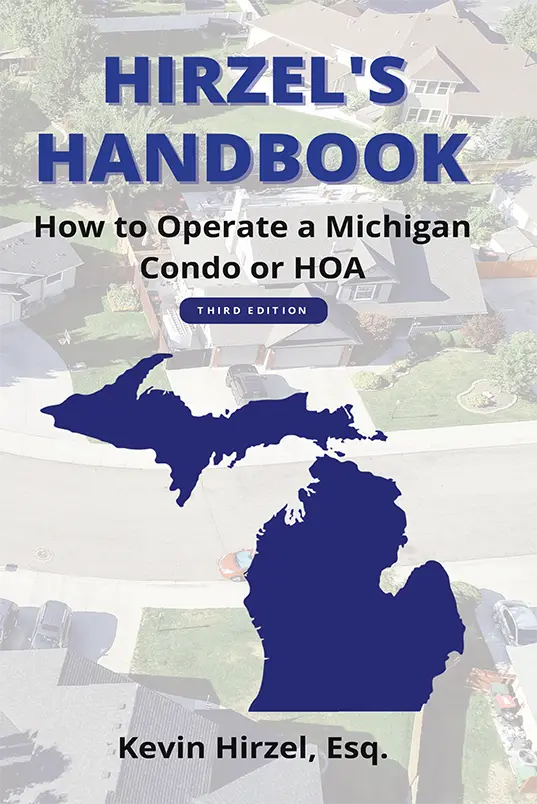
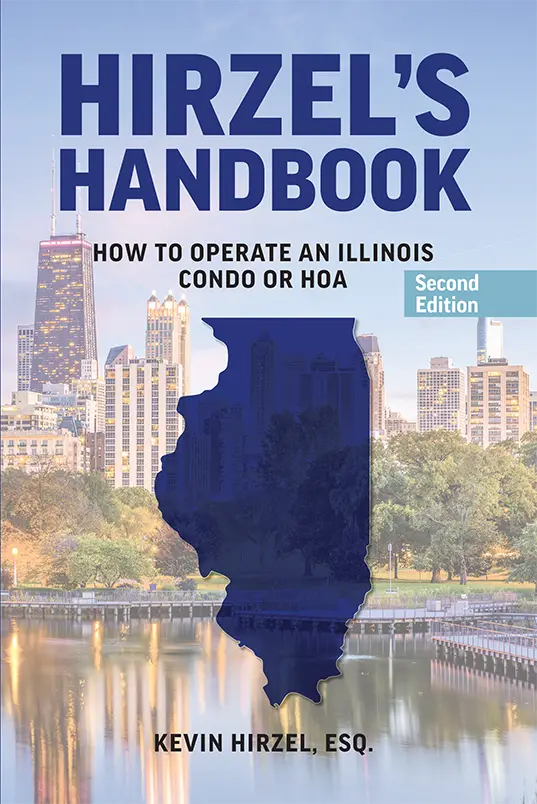
Hirzel Law provides educational resources for condominium and HOA board members and property managers, including Hirzel’s Handbook: How to Operate a Michigan Condo or HOA, Hirzel’s Handbook: How to Operate an Illinois Condo or HOA, legal blogs and updates, educational seminars and webinars, and other community association resources.
Frequently Asked Questions
Reducing HOA Legal Fees: FAQs
Should an HOA use its property manager for legal advice?
No. A good community association manager can be an important partner in controlling legal expenses, organizing information, implementing procedures, maintaining records, and carrying out the attorney’s recommendations. But legal questions should be directed to a community association attorney. Using a manager as a substitute for an attorney can expose both the association and the manager to unnecessary risk, particularly on Fair Housing, governing document interpretation, fines, collections, contracts, fiduciary duties, or potential litigation. The most effective relationships involve the board, manager, and attorney working within their respective roles.
Can an HOA charge attorney's fees and costs back to an owner?
Sometimes, but boards should not assume the answer is always yes. Recovery may depend on applicable law, the governing documents, the nature of the claim, and whether required procedures were followed. Before charging legal fees back to an owner, the board and manager should confirm the association has the authority to do so, and because governing documents differ, each association needs to understand what its own documents allow.
What are the best strategies for an HOA to reduce unnecessary legal fees?
The most expensive legal problems often arise when a community association:
- Waits too long to involve counsel
- Fails to follow established procedures
- Imposes unauthorized charges or fines
- Relies on nonlawyers or AI for high-risk legal advice
- Signs important contracts without review
- Uses outdated governing documents
- Pays another attorney to correct work not done properly the first time
The most cost-effective boards budget for predictable legal needs, involve counsel when the stakes justify it, communicate efficiently, and use experienced attorneys for the matters that carry the greatest risk.
How can Hirzel Law help your community association control legal costs?
Hirzel Law does not position itself as the lowest-cost or the most expensive community association law firm. Our goal is to provide value through experience, responsiveness, efficient processes, and high-quality legal work. Our approach includes:
- A 24-business-hour response commitment for most client communications
- Practice-focused attorney teams so the right attorney handles the right type of matter
- Flat-fee pricing for certain collection services
- Ready Collect and other systems designed to improve efficiency
- Upfront questionnaires for governing document projects to reduce unnecessary revisions
- Governing documents drafted in plain English, not legalese
- Updating documents for changes in the law or mismatched operational practices
- Preventative legal guidance that addresses problems before they become more expensive
- Educational resources that help boards recognize legal issues earlier
For specific information about our fees, see:
Michigan Condo & HOA Legal Pricing
Illinois Condo & HOA Legal Pricing
Community Association Law
Need Legal Guidance for Your Condo or HOA?
If your condominium association or homeowners association wants to control legal expenses without sacrificing responsiveness or quality, Hirzel Law can help your board determine the most efficient way to address its legal needs.
Request a ProposalTalk with a Condo & HOA Attorney (866) 394-4642
This material is provided for general informational purposes and is not legal advice. Legal rights and obligations depend on the particular facts, governing documents, contracts, claims, and applicable law.