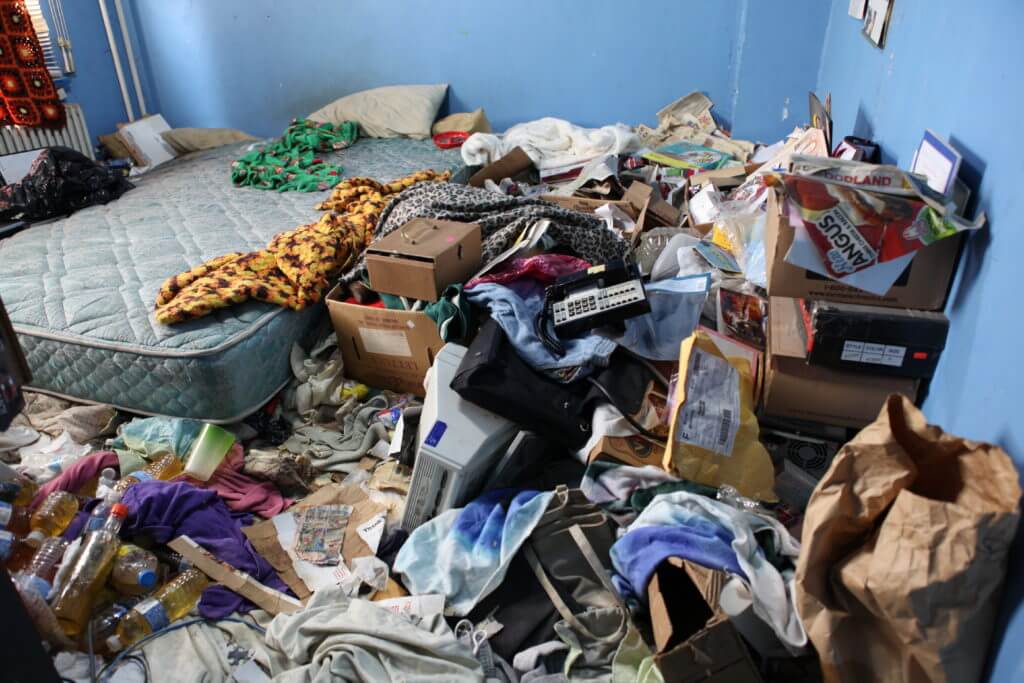
As the weather becomes warmer here in Michigan, many homeowners or co-owners undergo the yearly “Spring Cleaning.” Unfortunately, many condominium associations in Michigan face co-owners, tenants or residents who do not maintain the same sanitary living space as their neighbors. At the extreme, hoarders may fill units and/or limited common elements with debris, combustible material, food or other unsanitary or unsafe materials. This article explores the basics of hoarding and some practical steps the condominium association or property manager may take to alleviate the problem.
What is Hoarding?
Hoarding, also known as, Compulsive Hoarding, Collyer Syndrome, Syllogomania or Disposophobia, is a repeated pattern of behavior of acquiring large quantities of materials or objects coupled with the inability or unwillingness to discard those materials or objects. In 2013, the Diagnostic and Statistical Manual of Mental Disorders first labeled hoarding as a mental illness. According to a 2010 study, the prevalence of hoarding is estimated between 2-5% in adults.[1] Not only is hoarding dangerous or life-threatening for the hoarder, but may also be dangerous or life-threatening to adjacent or nearby co-owners, tenants or residents. Often, a hoarder’s unit may 1) attract roaches, ants or other insects 2) create mold or bacteria that affects walls or HVAC ducts 3) result in a ‘tinderbox’ in the event of a fire or 4) cause extensive odors or other nuisances to neighbors including health and safety concerns.
To be clear, there is a difference between someone who is merely a poor housekeeper and someone who is a hoarder. In Fountain Valley Chateau Blanc HOA v. Dept. of Veterans Affairs, 67 Cal.App.4th 743 (1998), the Court lambasted the association for its “high-handed attempt to micromanage” the owner’s housekeeping. The Court found that although the association claimed the clutter was a fire hazard, the fire department reviewed the situation and disagreed. Simply, a disorganized or cluttered unit does not rise to the level of a health or safety issue typically associated with hoarding.
Practical Options
While it should go without saying, when faced with a potential hoarder, an association should utilize common sense and, to the extent possible, compassion. However, compassion must give way to the health and safety of the hoarder or nearby neighbors. Below are various practical steps of what to do when learning of a potential hoarder:
- Contact the association’s board of directors and/or property manager in writing. Often the association and/or property manager will investigate or take further action such as reaching out to the suspected hoarder involved, speaking with family members of the potential hoarder or drafting bylaw infraction letters (typically with the help of an attorney). If the suspected hoarder gives access, an inspection may result in crucial information regarding the extent of any health and safety issues. If access to the unit is granted, we recommend that at least two people participate in the inspection to lesson any safety concerns of the individuals involved or claims by the hoarder of theft, damage or harassment/intimidation.
- Unfortunately, many times the hoarder will not voluntarily give the board of directors or the property manager access. If the association’s board of directors or property manager fails to resolve the matter or if access is denied,[2] the next step is to contact local public officials such as the police, fire department or health official. Involving the local police, fire department and/or health official may result in a hoarder’s willingness to allow for access. At the very least, a “health and safety check” is often a good means to gain at least limited access to the suspected hoarder’s unit.
- Under most condominium documents, the board of directors may have other powers and abilities to enter the suspected unit in the event of emergency situations. As a matter of prudence, the board of directors should be careful utilizing such provisions because such circumstances often result in litigation with a co-owner claiming damages, trespass, theft or a host of other claims.
- If the board of directors, property manager, police, fire department or health officials cannot obtain access, the association should contact an experienced condominium attorney, if it has not done so already.
Legal Options
An experienced condominium attorney will 1) review the facts as presented 2) review any documents, reports or pictures 3) review the condominium’s Master Deed and Condominium Bylaws, particularly Article VI: Restrictions in the Condominium Bylaws and 4) review MCL 559.165 and other relevant provisions of the Michigan Condominium Act. Once the review and analysis is complete, the attorney has a variety of options depending upon the situation. As a few examples, the attorney may write a letter to the suspected hoarder(s), file a lawsuit, obtain a court order for access or, in other states, seek the forced sale of the hoarder’s unit.
Conclusion
In our experience, having a knowledgeable condominium attorney involved early on in a potential hoarding situation is important and desirable. While the potential hoarder(s) may become contentious, not taking action may result in significantly larger negative consequences such as entire buildings being condemned, the potential for fires, or death or other injuries. If you know or suspect a hoarder in your condominium, please have your association contact our office.
Joe Wloszek is a Member of Hirzel Law, PLC where he focuses his practice on condominium and homeowner’s association law, commercial litigation, commercial real estate, large contractual disputes, and related real estate matters. Mr. Wloszek has been a Super Lawyers Rising Star in Real Estate Law from 2013-2018, an award given to only 2.5% of the attorneys in Michigan each year. He was also named a Top Lawyer in commercial law by DBusiness Magazine in 2014 and a Michigan Top Lawyer in real estate law by Michigan Top Lawyers in 2016. He is a Certified Real Estate Continuing Education Instructor through the State of Michigan and the past Chair of the Oakland County Bar Association Real Estate Committee. He can be reached at (248) 478-1800 or jwloszek@hirzellaw.com.
[1] Pertusa, A., Frost, R.O., Fullana, M. A., Samuels, J., Steketee, G., Tolin, D., Saxena, S., Leckman, J.F., Mataix-Cols, D. (2010). Refining the boundaries of compulsive hoarding: A review. Clinical Psychology Review, 30, 371-386.
[2] A more thorough article regarding accessing a unit may be found on our website titled Access Denied! … Or is it? The Condominium Association’s Right to Request Entry to a Unit to Inspect for Default.