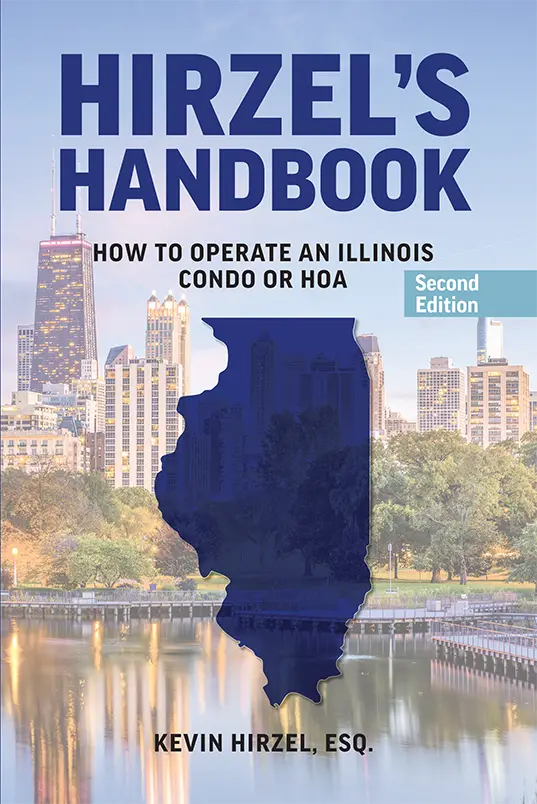
2nd Edition — Illinois
Hirzel's Handbook
Want to learn the best practices for operating your Condo or HOA? Get your copy of Hirzel's Handbook 2nd Edition: How to Operate a Illinois Condo or HOA.
Also available on Kindle

About the Handbook
Your Complete Guide to
Community Association Management
About Hirzel’s Handbook
Need help learning the legal requirements and best practices for operating a condominium or homeowners association? Hirzel’s Handbook is a step-by-step guide for everything you need to know to successfully manage an Illinois community association. The book was designed as a resource for volunteer board members and property managers to understand the basic principles of community association operations, as most board members and property managers only receive “on the job training.” Hirzel’s Handbook fills the void and provides sage advice from an experienced community association attorney on properly operating a community association and avoiding common problems. The handbook covers operational issues, such as, architectural control decisions, association finances, corporate governance, meetings, and insurance. After reading Hirzel’s Handbook you will also understand how to handle more complex issues, such as transitioning an association from developer control, bylaw enforcement, collections, amending the governing documents, and Fair Housing.
Chapter Overview
What's Inside the Handbook
Each chapter covers a critical area of community association management, providing practical guidance you can apply immediately.
Introduces the basic principles governing community associations in Illinois, including the hierarchy of applicable laws - from federal and state statutes to municipal codes, governing documents, and rules and regulations.
Chapter one explains the different types of Illinois community associations, including traditional and business condominiums, mixed-use projects, common interest community associations, master associations, and cooperatives.
Chapter two covers budgets, assessments, surplus and reserve funds, reserve studies, association loans, financial statements, tax returns, and tax appeals for condominiums and common interest community associations.
Chapter three addresses association and board meetings, voting, proxies, quorum requirements, electing directors and officers, meeting minutes, books and records, director and officer duties, and conflicts of interest.
Chapter four covers day-to-day association operations including architectural approvals, resale disclosures, contracts, maintenance and repair obligations, heating and cooling requirements, and professional property management.
Chapter five reviews insurance requirements for associations, including general liability, property, directors and officers, crime and fidelity, cyber, workers' compensation, and homeowners insurance policies.
Chapter six guides associations through the developer turnover process, including the transitional control meeting, turnover checklists, identifying construction defects, developer liability theories, and financial obligations.
Chapter seven Explains how associations enforce their governing documents, covering conduct violations, construction violations, and available remedies including fines, injunctive relief, monetary damages, and attorney's fees.
Chapter eight details the assessment collection process, including liability for assessments, collection policies, evictions, liens, lien priority, judicial foreclosure, post-foreclosure assessments, and bankruptcy considerations.
Chapter nine walks through updating articles of incorporation, declarations, and bylaws, covering governance, financial, insurance, compliance, and technology issues, plus the amendment process and rules and regulations.
Chapter ten explains fair housing compliance for associations, covering disability discrimination, emotional support animals, familial discrimination, race and national origin issues, religious discrimination, and sex discrimination.
Chapter eleven addresses options for financially or physically distressed condominiums, including the deconversion process for associations considering termination and sale of the property.
The conclusion reinforces that a well-run association depends on the commitment of its board and owners, encouraging readers to apply the handbook's guidance to build a stronger community.