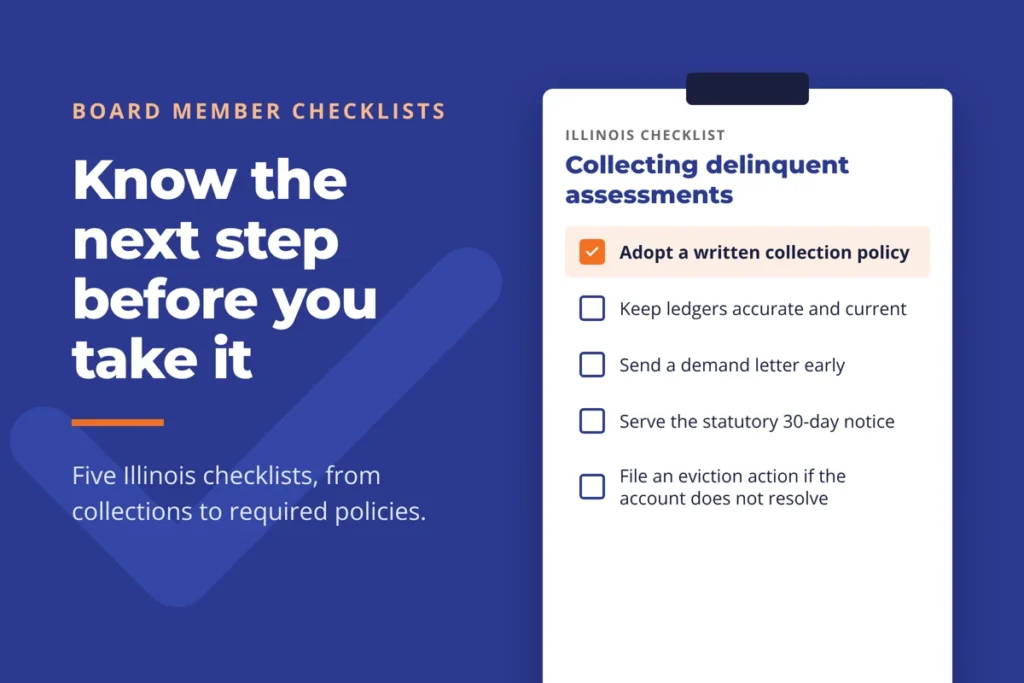
Our Illinois condo or HOA already collects a certain way. Do we still need to do anything?
Yes. An informal practice, or a condo or HOA collection policy adopted years ago, may not satisfy the specific content requirements. The safer course is a written policy reviewed against the required elements and formally adopted.
What happens if we file a collection case without a compliant condo or HOA collection policy?
Public Act 104-0734 prohibits legal action by an Illinois condo or an HOA that is subject to CICAA unless the required collection policy is adopted. A delinquent owner could raise the missing policy as a defense, which can delay recovery and put an otherwise ordinary collection matter at risk.
Can our condo or HOA adopt a collection policy template we find online?
A form that conflicts with your governing documents or misstates your late-fee structure can create new problems. Incorrect provisions about late fees, interest, payment plans, or collection remedies can create disputes and delay recovery of unpaid assessments. Simply having a written policy does not mean it complies with the new law. Similarly, AI-generated forms can be inaccurate and do not provide the board with the protection of the business judgment rule in relying on the advice of a community association attorney if something in the online template is incorrect or does not comply with the law.
Do the owners have to vote on the policy?
No. The statute places the duty on the board. The board should adopt the policy at a properly noticed open meeting and confirm whether its own governing documents include any procedural requirements.
Does the new collection policy law apply to small condominium and homeowners associations?
The Illinois Condominium Property Act requires all condominium associations to adopt a collection policy, no matter their size or budget. Homeowners and townhome associations subject to the Common Interest Community Association Act must also have a collection policy. However, CICAA exempts common interest community associations with 10 or less units or a budget that is $100,000 or less from complying with CICAA, unless the community association decides to opt in to CICAA’s requirements. Given that budgets can change over time, having a collection policy is always a good practice, and it is typically best for all community associations to have one.
How much does a condo or HOA collection policy cost?
Hirzel Law prepares a written collection policy for an Illinois association for a flat fee of $500.