Introduction
The recent water crisis in Flint, Michigan has gained regional and national headlines and caused a great deal of controversy regarding the responsibility of local, state and federal government to provide clean water. One of the biggest issues facing Michigan condominium associations today, albeit rarely discussed, is the aging infrastructure located underground in the common elements of the condominium association. This article explores practical steps that your condominium association could take to make sure the water is safe for your family and neighbors. Given the recent issues in Flint, Michigan, no longer is the maxim of “out of sight, out of mind” an excuse or justification for inaction.
Safe Water Drinking Act
In 1974, Congress enacted the Safe Water Drinking Act, 42 U.S.C. 300f, et seq. The Safe Water Drinking Act was amended in 1986 to prevent the use of lead pipes in residential structures, and provides in pertinent part, “No person may use any pipe, any pipe or plumbing fitting or fixture, any solder, or any flux, after June 19, 1986, in the installation or repair of— any plumbing in a residential or nonresidential facility providing water for human consumption, that is not lead free.” 42 U.S. 300g–6(a)(1)(A)(ii). Condominiums that were constructed prior to 1986, and conversion condominiums that were created after 1986, but contain pre-1986 construction, may contain lead pipes. Given that common element lead pipes are likely at least thirty (30) years old at this point, and the original co-owners and developer are long gone, many associations may not have considered if their project contains lead pipes. While governmental entities certainly have an obligation to deliver clean water to their citizens, condominium associations are often charged with maintaining and repairing the general common elements. As indicated in the recent lead advisory warning from the City of Flint:
Typically, lead gets into your water after the water leaves your local treatment plant or your well. That is, the source of lead in your home’s water is most likely pipe or solder in your home’s own plumbing. The most common cause is corrosion, a reaction between the water and the lead pipes or solder. Dissolved oxygen, low pH (acidity) and low mineral content in water are common causes of corrosion.[1]
The below picture also demonstrates that the source of lead contamination often comes from service lines that are not part of the public water system. [2]
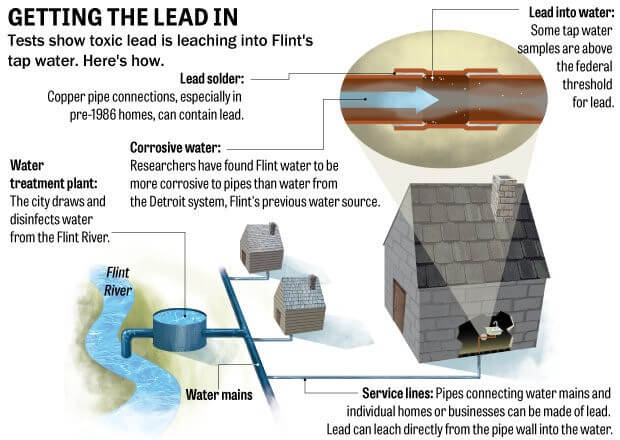
Accordingly, even if the municipality delivers clean water to a condominium project, a possibility exists that lead pipes in condominiums that contain older infrastructure could cause water contamination.
Michigan Condominium Act
The Michigan Condominium Act, MCL 559.101, et seq., does little to expressly regulate water quality issues. MCL 559.171a only requires that the Michigan Department of Health and Human Services review a condominium subdivision plan and ensure water quality in situations where the condominium will not be served by public water and public sewers upon creation of a condominium. Presumably, this is due to the fact that the Michigan Safe Water Drinking Act, MCL 325.1001, et seq. regulates water quality with respect to public water supplies that would serve a condominium.
Pursuant to MCL 325.1005a, a supplier of public water “may discontinue water service to customer site piping as the supplier of water or the department considers necessary to protect the health of the public water supply customers.” Pursuant to MCL 559.103(7) and most Michigan condominium’s Master Deed, the “customer site piping” that provides water throughout the condominium will typically be a common element. In most cases, a condominium association will have a contractual obligation to repair and/or replace the general common elements, which typically include a responsibility to ensure that the common element piping, up to the point of connection to a co-owner’s unit, is not polluting the water supply. In addition to creating health risks, a supplier of public water could potentially discontinue service to a condominium if a condominium association avoids addressing water contamination that has been caused by lead pipes. Accordingly, we recommend that the board of directors of an older condominium association be proactive and take the following steps with respect to water quality issues:
- Investigate. The Board of Directors could contact their local municipality to see if the Building Department has any records as to what type of piping was used at the time the infrastructure was constructed.
- Test the Water. If a condominium association knows that it has lead pipes, or it has received co-owner complaints regarding water quality, a condominium association could perform a water test to determine if the water contains unacceptable levels of lead of other pollutants. Water testing is relatively cheap and additional information on water testing can be obtained from the Michigan Department of Environmental Quality.
- Assess Potential Liability. We recommend that a board of directors consult with its attorney if it becomes aware of potential issues with lead pipes. It is unlikely that an association would be able to pursue a developer for the installation of lead pipes, as the use of lead pipes was likely permissible at the time and the statute of limitations has long since passed. However, MCL 450.2541 requires that each director of a condominium association act “in good faith and with the degree of diligence, care, and skill that an ordinarily prudent person would exercise under similar circumstances in a like position.” MCL 450.2541 specifically requires that directors discharge their duties by acting in good faith when they rely upon the advice of their attorney and other professionals. Accordingly, directors face potential liability if they do not consult with experts, such as an attorney, and ignore known issues associated with lead contamination.
- Consult the Experts. In the event that common element pipes are determined to have caused increased levels of lead in the water supply, we recommend that the condominium association consult with the local municipality, the Michigan Department of Environmental Quality and the Michigan Department of Health and Human Services to determine the appropriate course of action.
- Implement Expert Recommendations. In addition to health screening, and any other steps that are recommended by the above governmental agencies, it is likely that a condominium association may need to replace any lead pipes. A condominium association should immediately contact several plumbers and obtain quotes with respect to the pipe replacement. The cost associated with the pipe replacement is likely an unbudgeted expense that will need to be paid for through an additional assessment or from a condominium association’s reserve fund. Given the potential safety hazards and liability associated with not replacing lead pipes, the Association should follow the above recommendations of their experts.
Conclusion
Unplanned expenses and safety concerns regarding hidden infrastructure in older condominium projects is emerging as a real problem. Common element lead pipes pose safety concerns and older condominium associations should take immediate action when they become aware of potential issues. Failing to do so could have disastrous consequences for the health of the co-owners and expose an association and its directors to potential liability if they fail to take appropriate action.
Kevin Hirzel is the Managing Member of Hirzel Law, PLC and concentrates his practice on commercial litigation, community association law, condominium law, Fair Housing Act compliance, homeowners association and real estate law. Mr. Hirzel is a fellow in the College of Community Association Lawyers, a prestigious designation given to less than 175 attorneys in the country. He has been a Michigan Super Lawyer’s Rising Star in Real Estate Law from 2013-2018, an award given to only 2.5% of the attorneys in Michigan each year. Mr. Hirzel was named an Up & Coming Lawyer by Michigan Lawyer’s Weekly in 2015, an award given to only 30 attorneys in Michigan each year. He represents community associations, condominium associations, cooperatives, homeowners associations, property owners and property managers throughout Michigan. He may be reached at (248) 478-1800 or kevin@hirzellaw.com.
[1] https://www.cityofflint.com/public-works/lead-advisorywater-quality/.
[2] This picture was originally published in “Here’s how that Toxic Lead got into that Flint Water”, Ron Fonger, October 7, 2015, http://www.mlive.com/news/flint/index.ssf/2015/10/see_step_by_step_how_lead_is_g.html